Veröffentlicht am: 24.09.2026 um 11:50 Uhr:
ca. 3 Minute(n) Lesezeit
REHACARE International: Assistive Devices Are Key to Independent Living, but Access Remains a Challenge
» Assistive devices improve independence and participation
Assistive devices are far more than medical products. For millions of people, they are essential tools for managing everyday life independently, participating in society and remaining in employment. Yet obtaining the right device can be a challenging process.
This is one of the central findings of the REHACARE Report 2026, “Self-Determined Living – Status Quo and the Future of the Provision of Medical Aids in Germany”. The study surveyed 1,527 adults in Germany who regularly use assistive devices and had experienced application, approval, adaptation or repair processes within the previous five years.
The results underline the importance of appropriate provision. Some 95% of respondents said assistive devices had a positive impact on their daily lives, while 86% reported greater independence as a result.
Whether a wheelchair, hearing aid, prosthesis, incontinence aid or digital assistance system, the right solution can help users maintain mobility and communication, participate in working life and manage their everyday activities more independently.
Bureaucracy remains a major obstacle
At the same time, the report identifies considerable barriers within the current system. Two-thirds of respondents said they felt burdened by bureaucracy, while 76% believed that receiving good-quality provision requires persistence and knowledge of how the system works.
Overall, 68% said they were satisfied with their assistive device provision, leaving roughly one-third dissatisfied.
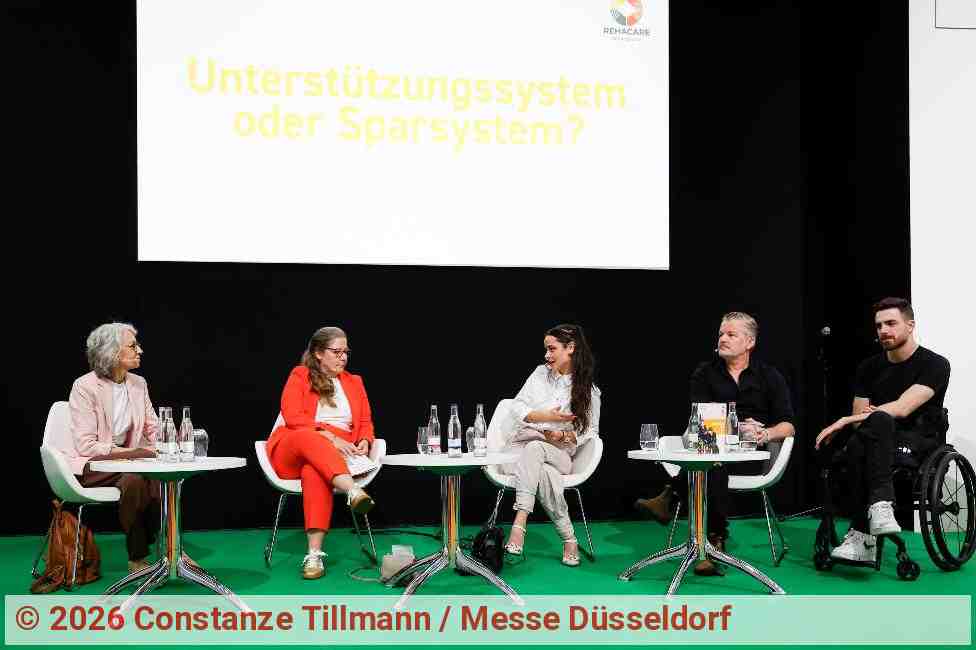
Opinions about the system itself are similarly divided. While 52% view it as a support system for users, 49% perceive it primarily as a mechanism for cost savings by funding bodies. Younger people are particularly critical: among respondents aged 18 to 29, 63% described it as a savings-based system. Women and people on lower incomes also assessed provision more critically.
Cost pressures raise questions about future provision
The findings come amid a broader debate in Germany about healthcare expenditure and the financial sustainability of statutory health insurance.
According to the REHACARE report, assistive devices accounted for 3.87% of the total statutory health insurance budget for around 32 million cases of provision in 2023. At the same time, the report argues that appropriate assistive technology can generate benefits beyond the immediate healthcare setting.
Enabling people to remain independent or stay in employment can potentially reduce pressure on relatives and limit the need for additional care. The report therefore cautions against blanket cost-cutting measures in a field where individual requirements, professional consultation, adaptation and ongoing service play an important role.
Savings made at the point of provision could instead shift expenditure elsewhere, including nursing care, hospital treatment or absence from work.
Focus on individual needs and transparent processes
The report concludes that high-quality assistive device provision depends not only on suitable products, but also on professional advice, effective processes and transparent decision-making.
It calls for skilled professionals to be given greater responsibility and for stronger interdisciplinary cooperation. With demand for care increasing, the report argues that a system focused on participation and independence should place individual needs and understandable decisions at the centre of provision.
The REHACARE Report 2026 was presented on 23 September at the opening of REHACARE International 2026. The underlying online survey was conducted in Germany in March 2026 by INNOFACT AG and involved 1,527 adults who regularly use assistive devices. The sample was representative of the population in terms of age and gender. «
Source: Press release from Messe Düsseldorf GmbH dated 23 September 2026 / edited with the help of Copilot (AI)